

salome
poetry, flash fiction, and a note from the author

This post has three parts. Salome (poem), Salome (flash fiction), and a ramble that include my thoughts and a brief history. Take whatever interests you and feel free to leave the rest.
Salome (poem)
i, nothing but flesh, blood, and wind.
i, of my mother’s bloodlust.
i, of my father’s rage.
for whom do i dance?
not for him.

feet, white as moonlight
flying free as swans
yet lust weighs me down like shackles
womanhood a prison in itself
i do not dance for
i dance in spite,
with spite.

your head or my life.
it was always one or the other.
you, the mouthpiece
and i, the voiceless.
for whom do i dance?
for me.
for me.
for me.

Salome (flash fiction)
I never wanted his head. I only wanted to dance. Alone, beneath the glittering midnight sky, with only the pearl-white, moon-eye of god as my witness as I had done many nights before. But that was not my fate, not tonight.
My disgust at the scene before me is hidden by layers of silk, gauze, and other fine fabrics that shield my most betraying features. With eyes ensconced, I study the bloated, bloodred faces of the men who take everything - alcohol, food, women, lands, slaves, fortunes - in excess. Honeyed, dark wine dribbles out of the mouths of noblemen three times my age. Liquid on which no expense was spared mixes with sweat and spit as it traces its way from the corners of overloud mouths and down the curled hairs of greying beards. Droplets of this foul man-poison suspend themselves for a moment before falling victim to the nature of gravity and staining the rich cloths of their robes. While I can be nothing less than pristine, men in power lower themselves to something akin to pigs in this dining hall on a regular basis.
The room reeks of greed as they request refills of goblets made of the most precious metals. No words are spoken, they just grunt something primal and thrust their grubby fists in the face of whichever unfortunate servant happens to be passing by. All the while they never remove their eyes from my hidden face. Among these men is my stepfather, and it is his eyes who gaze the most hungrily. Here in my half-home I am but a prize. Just another commodity with which to taunt guests. To show off, to impress. To dangle in front of lesser men as if to say Look what I possess that you never will. I am not my own. I never was.
It is not like I had any kind of choice. If my stepfather made the request for my presence tonight, it was my mother’s insistence that condemned me to be here. She could have said no. She could have kept me hidden away if she truly wanted. A precious jewel safely nestled in the inner velvet of a treasure box . Yet she did not. Such a lovely gift for his birthday celebration, my dancing would be, she had cried as she had clasped her hands together in excitement. My affinity and talent for dance were known, though not often seen. I preferred to dance alone. It was my moment of freedom from the suffocating prison of my stepfather’s watchful gaze and the whispers of the palace workers. In those moments, I let my body and mind wander in ways I usually did not dare. Only in those private moments did I let hope flourish within me. Only then did I believe God was good.
But I could not say no tonight. I was to have an audience. My body was not mine to deny. I would serve my father and his guests. And I would serve my mother, too. After all, if my stepfather’s eyes were on me, then she would be free for the night from his grabbing hands and his lingering gaze. I had no protector here. I was a weapon to be wielded. A war to be waged.
So I do what I am told, as any good daughter does. I bite my lip in feigned seduction. I twirl my hips in ways that would make whores blush. I veil then unveil myself like a fresh bride. Not because I want to. Not because I desire any man here. But because the consequences if I don’t are dire. My eyes scan the room, meeting the drunken eyes of men whose names I will never know. If I get close enough, I can smell their fermented breath, see the spit stains on their clothes. I do not know a word in any language for the vile comments made at my expense, but I feel them diminish my very essence. These royal men are reduced to drunken boys in my presence, and I am merely a girl with but one use in the eyes of the world.
What they do not know is that I am also the coalescence of my mother’s bloodlust and my stepfather’s rage. For every comment thrown my way, I let it fuel the fire that burns in my throat and in my belly. I let it spark the twinkling in my eye that I permit to linger for just a half-second too long on each of the men here. I make them feel special. I make them feel what their wives do not. As my feet twirl and flitter in the moonlight, it is my hatred that propels me. Hatred for my mother. For my stepfather. For these men and this place. My own place in this world. And God for letting it all happen.
And yet, I did not want his head. He was thrown carelessly in the old cistern as a makeshift prison because my father did not have the guts to kill him. They call him Yohanan. His followers swear him a holy man who speaks directly to God, and while my father could exercise his power, he dare not exercise his sword. He did not want that blood on his aging hands. A proclaimed prophet of God would be a surefire way to start a rebellion. My father did not want to incite something he could not put an end to. And while I did not want that stain on my soul, it was also the only way I could free it.
I knew my father would be pleased with my performance, and in his drunken stupor would make promises he did not intend to keep. However, this time he had witnesses, and I, a thirst for revenge. When the moment comes, his hands shake and words are slurred. He does as I expect. He promises me anything I desire. Half his kingdom. Jewels. Silks. Wines. Anything, anything, Salome. And I, just a girl, am expected to ask for something tangible and pretty. Superficial and elegant. Not blood. Not this man’s. I smile demurely before I whisk away to consult my mother. His eyes flash in fear for a brief moment when he realizes where I am going. This, he did not expect, but he should have.
My mother had been calling for his head from the beginning. She screamed until she was catatonic that he slandered her name and spoke untruths. It’s true he spoke against her, but he never uttered one lie. He condemned my mother’s divorce and remarriage. Called it incestuous. An abomination. A violation of law. A sin and a sign. She could not bear to hear it. She couldn’t face this mirror that he spoke into existence. It was too much. So when I left to consult her, I knew what request she’d impress upon me. And who was I to deny her?
I linger a few moments longer than I should before returning to the dining hall. Hoping the anxiety would eat at my stepfather’s soul a little longer. He is disheveled when I return. The men with whom he had been celebrating continue to drink and laugh amongst themselves, but my father is withdrawn and rings his hands in the corner. He is near tears when I approach him. I look him in the eye when I say it. And I say it so sweetly that the honey of my words almost dilutes the wickedness of what I am saying. Almost.
He knows what will become of his reputation. Whatever trust and goodwill still exist toward him will be destroyed. He is more scared of public opinion than what God will do to him, I can see it in his nervous movements. Public opinion and God be damned, I fear nothing more than for my life to continue as it is.
It is brought to me on a platter. Hair slick with blood. Eyes closed. Mouth slightly ajar as if he was still praying when the sword broke skin and bone. The bile in my stomach rises to my throat, but I swallow it back down. I could not show fear. I could not show disgust. I was a dangerous woman, and they all had to know. They all had to believe.
I kiss those parted lips. I breathe a prayer of my own into them, hoping God’s mouthpiece worked both ways. I do not ask for God for His forgiveness. No, I ask for Yohanan’s. He had to know I didn’t mean it. I never wanted his head. I never even wanted him. I wanted freedom. I wanted safety. I wanted men to be too afraid to ever look at me again. They needed to know the power I wielded, and this was the only way.
I could never cleanse my soul of what I had just done, but neither could anyone else here. We were all complicit. Sinfully bound. It would be written about, I knew it already. My mother’s wickedness, my faithful obedience, and my father’s foolishness. Holiness was destroyed with my own hips and tongue and God knew. He watched it all. Every moment. And I hope it pained Him. I will gladly pay for my sins centuries and centuries over, if they only believe that I, a woman, for a moment, brought the world to its knees.
A Ramble and Look Inside of My Still-Attached Head
Confession: I love writing about women in myth and history. I am not an expert historian by any means, but through my casual consumption of literature, podcasts, and film, I find myself drawn to the stories of so many women. Women who are viewed as wicked, villains, or witches fascinate me (as seen in my poems helen and medea), but so do women and girls whose agency have been taken from them (see: kallisto, iphigenia, kassandra, and ophelia).
I am not the first to do this nor am I the best (or even good, honestly). There has been a rise in the popularity of novels such as Circe by Madeline Miller, Elektra by Jennifer Saint, and Jezebel be Megan Barnard, to name a few, that reimagine stories of mythical and/or historical women and grant them (or attempt to grant them) the agency and complexity they have canonically been denied.
These women, as of late, have been my greatest muses. The poems I write about them I let speak for themselves. I let the reader decide how deeply they want to wade into each woman’s lore (or recognize it if they already know it) . And while I may be hitting readers over the head by naming these pieces after the women who have inspired them (history and men have taken their voices - I won’t be the one to take their names), I also don’t usually intend for them to be read only as a retelling of the subject. I am drawn to each woman either through personal connection or the larger social implications that surround their stories, and I hope the intertwining of these layers of meaning create work with complexity and value.
Obviously, as a writer, I take liberties with the known histories and mythologies in order to emphasize the message I am trying to convey (and, honestly, sometimes just to fit the particular sound I want). As I said above, I am also no expert, I am just a girl on the internet inspired by other girls I learn about on the internet.
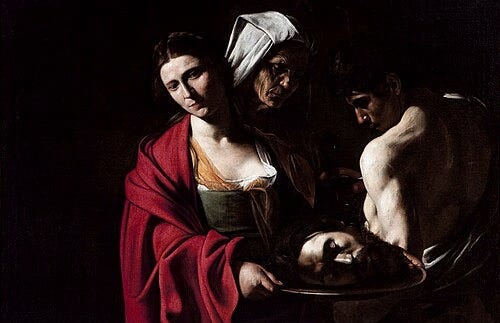
When I was in Florence this summer (how pretentious, I know), I found myself drawn to a painting of a woman holding a man’s head on a platter. Not in a kill all the men kind of way, but in a what is the real story here way. The imagery is delightfully dark and sinister, and I wanted to know the truth of whoever this woman was. After looking into it, I stumbled upon the story of Salome. I had a brief encounter with Salome when I did some reading on John the Baptist a few months ago, but until then, I was largely unfamiliar with her story (weirdly this wasn’t touched on in any Sunday School classes I attended). The more I looked into her, the more disappointed I became that, as far as her story goes, there isn’t much to it besides the generic “She’s a slut and she’s evil!” As if I will ever believe that is all there is.
For those unfamiliar, here is the summary. Salome dances for her stepfather (Herod Antipas) for his birthday celebration (later variations of this story seem to characterize her dance as sinfully seductive despite the fact that she is generally believed to be a child between the ages of twelve and sixteen). Her stepfather was so pleased (or in later stories, seduced) by her dancing that he promised her anything she wanted. Salome’s mother, Herodias, tells Salome to ask for the head of John the Baptist, who had been imprisoned by Herod for speaking against the marriage of Salome’s mother and Herod due to its violation of religious law (Herodias was married to Herod Antipas’ half-brother, Philip, but Herodias divorced him for Herod ). Herod, reluctantly, grants her wish, and John’s head is given to her on a platter.
Salome’s name is not mentioned in the Bible verses that recount this story (Matthew 14:1–12 and Mark 6:14–29). We get her name from the historian, Josephus in Book 18, Chapter 5 of Jewish Antiquities. And despite it only being briefly mentioned in two of the gospels, Salome’s villainy has seemingly taken on a life of its own. Countless artists have painted this scene, Oscar Wilde wrote the French play Salomé that was later turned into a German opera by the same name, Gustave Flaubert wrote the short story Herodias. What all these stories have in common is that Salome is portrayed as a fille fatale1 who knows full well what she is doing.
But what if that’s not her story? What if, as a result of her circumstances, Salome was a victim of her parents searching for any sense of agency and freedom in the only way she could? There were several ways this alternate story could go in my mind, and I wasn’t sure where mine would end until I got there. To me, Salome does not have a choice in whether or not she dances, but she is able to cunningly manipulate the situation to her advantage. She plays the part. And while she knows history will not remember her fondly, it is the sacrifice she is willing to make in order to escape the predatory clutches of her stepfather and to bring down her self-serving mother (it’s no secret she wanted him dead).
I also debated whether or not to even write this as a short story or poem. I started out with a few lines of a poem, but felt flash fiction served her story better (and experimenting with fiction again is something I have been meaning to do); however, as a self-proclaimed poet, I couldn’t not write a poem as well.
I hope that one or both of these pieces stir something within you. And I hope that, if you weren’t already, you begin to question the centuries old narratives about women and girls that have been written by a misogynistic world.
violent ends is a free publication! the best thing you can do to support my work is to share it with others and interact with it. if you want to support me financially with a one-time donation, you can also use my link to buy me a coffee.
fatal girl
Beautiful ❤️ You're imagery is absolute amazing. Thank you for this.
I love how rich your pieces are, how different types of writing come together as one beautiful tapestry of the same story❤️