

white fay (poem)
you’ve heard this tale in other tongues before.
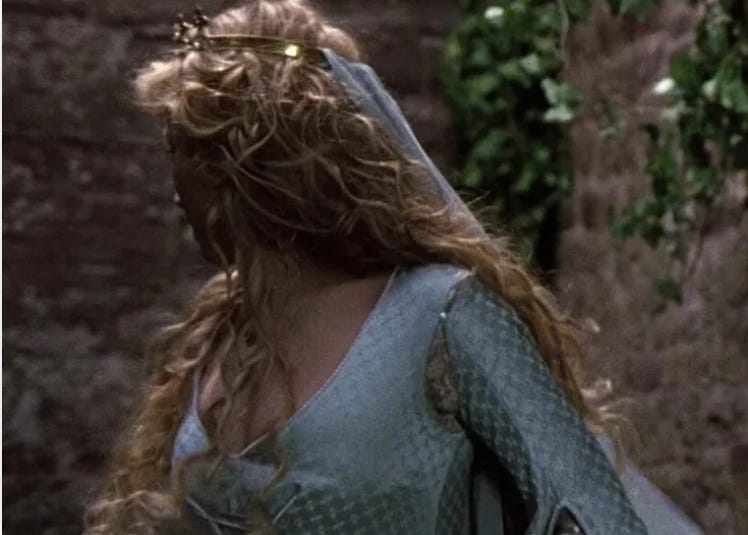
Poem #8, Guinevere. Her lore runs deep. I could probably spend months upon months diving into all of the literature, film, and academia surrounding her, and I was very tempted to. For the sake of brevity, I’ll give you the key points you need to know about Guinevere. If you’d like to know more, you can check out the sources I used at the end of this article.
Guinevere dates back to pre-Christian, Celtic origins but became Christianized over time.
She is mentioned in various pieces of literature prior to the Vulgate Cycle and Le Morte D’Arthur, but these two were the basis for my research and the poem.
Quick main-plot summary: Guinevere marries King Arthur. Merlin warns Arthur she will be unfaithful, but he marries her anyway. Ober time, she begins and maintains a love affair with one of Arthur’s knights, Lancelot. Lancelot and Guinevere have a passionate, complicated relationship based on the principles of courtly love. Lancelot is devoted completely to her, and this devotion is their undoing. Several of Arthur’s knights are aware of the affair and want to expose it. The trap is successful, and Guinevere is sentenced to be burnt at the stake. Lancelot rescues her from death. As a result of this infedility. there is civil war that ultimately leads to the death of Arthur and Mordred (his son with his half-sister - hypocritical, right?) Guinevere retires to a nunnery for the rest of her days while Lancelot also retires to a life of hermitage.
There is a LOT more that goes into the story of Guinevere, but I feel thar those are the essentials. This poem was hard for me to write because there were so many concepts I wanted to pack into it without it just being a chronological retelling. Ultimately, I decided to focus on the following:
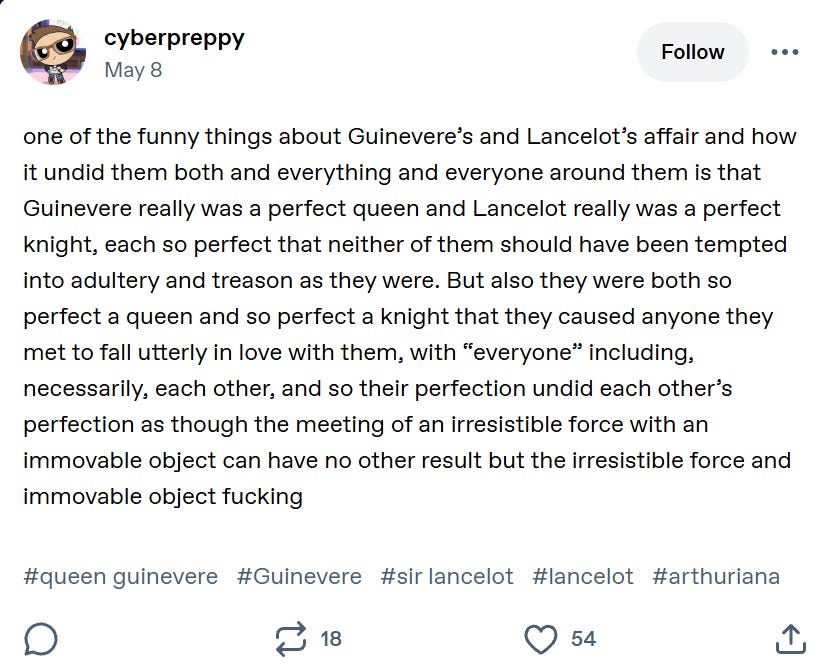
Guinevere as a mirror to other “doomed” women such as Eve and Helen.
How often men are forgiven and even seen as heroes for their actions while women who commit the same actions are considered villains.
The pain of making difficult choices.
Fate v. freewill; duty v. desire
Guilt for what one cannot control and hope for forgiveness from a higher power.
“When Sir Launcelot was brought to her, then she said to all the ladies: Through this man and me hath all this war been wrought, and the death of the most noblest knights of the world; for through our love that we have loved together is my most noble lord slain. Therefore, Sir Launcelot, wit thou well I am set in such a plight to get my soul-heal; and yet I trust through God’s grace that after my death to have a sight of the blessed face of Christ, and at domesday to sit on his right side, for as sinful as ever I was are saints in heaven. ”
-Book 21, Chapter 9 of Le Morte d’Arthur
white fay
heartsin –
a crime of passion;
a kingdom in ruins.
you’ve heard this tale
in other tongues before:
a great woman
stumbles
and falls
headfirst into
temptation
bringing an even
greater man
to his desperate knees.
a casualty in slow motion,
he is
venerated
and she is
vilified.
heartsick –
i will not carry
eve’s burden
when this knife
twists both ways.
pull the steel
out of your back,
dare to say you don’t
see my blood
on it too.
it is no trick
of the light;
no simple thing
to cleave
duty from desire;
to be faulted for
phantom faithlessness
i couldn’t have foreseen.
heartsunk –
haunting
the edges of
history
and myth.
looking for a way
in without
slashing all the way
through.
looking for an omen
that i am not the
White Lady
but the white dove.
Caerleon falls
in carelessness;
blood on sheets,
blood at Camlann,
blood on hands.
i renounce it all;
i regret it in
retrograde motion.
we can no longer
be savior to ourselves.
we can only throw
ourselves on the altar
of devotion.
god helps those
who help themselves.
god only knows
all we’ve done, all
we’ve spoken.
Other poems in this series that can be read in any order:



violent ends is a free publication! the best thing you can do to support my work is to share it with others and interact with it. if you want to show support in other ways you can also buy me a coffee.
Sources:
Grady, Jessica. Power, Courtly Love, and a Lack of Heirs: Guinevere and Medieval Queens, Marshall University Libraries, 2009.
“Guenevere.” Nightbringer.Se, nightbringer.se/the-legend-of-king-arthur/arthurian-characters/g-arthurian-characters/guenevere/. Accessed 21 July 2026.
“Guinevere .” Robbins Library Digital Projects, University of Rochester, d.lib.rochester.edu/camelot/theme/guinevere.html. Accessed 21 July 2026.
“Guinevere.” Wikipedia, en.wikipedia.org/wiki/Guinevere. Accessed 21 July 2026.
Hodges, Kenneth. “Guinevere’s Politics in Malory’s ‘Morte Darthur.’” The Journal of English and Germanic Philology, vol. 104, no. 1, 2005, pp. 54–79, http://www.jstor.org/stable/27712477.
Hollis, Morrigan. “In Defense of Guinevere.” NOCTUA: Journal of Medieval and Renaissance Studies at The W, vol. 2, no. Spring 2017, pp. 25–31, https://doi.org/https://www.muw.edu/images/colleges/as/hpg/noctua/vol2/Noctua_vol2.pdf#page=31.
Ingvarsdóttir, Marie Helga. “Queen Guinevere: A Queen through Time.” Háskóli Íslands, Skemman, 2011, https://skemman.is/bitstream/1946/8367/1/Queen%20Guinevere.pdf.
Jesmok, Janet. “Guiding Lights: Feminine Judgment and Wisdom in Malory’s ‘Morte Darthur.’” Arthuriana, vol. 19, no. 3, 2009, pp. 34–42, http://www.jstor.org/stable/27870973.
Mark, Joshua. “Guinevere .” World History Encyclopedia, World History Publishing, www.worldhistory.org/Guinevere/. Accessed 21 July 2026.
“Queen Guinevere.” Early British Kingdoms, Nash Ford Publishing, earlybritishkingdoms.com/bios/guinever.html. Accessed 21 July 2026.
i love love love the research & thought that goes into all of your poems. your use of "heartsunk" is perfect...it really describes her story.
This piece is beautiful, I love all your poems and just subbed. I’d love if you checked out some of my work too as a fellow poet :)